Friday, October 9, 1:00 PM – 2:00 PM ET/12:00 PM – 1:00 PM CT/11:00 AM – 12:00 PM MT/10:00 AM – 11:00 AM PT
Earlier this year, in Bost v. Illinois State Board of Elections,the Supreme Court held that candidates for office have standing to challenge election rules simply by virtue of being a candidate. Supporters of this expansive interpretation of candidate standing have lauded it as a victory for the rule of law by allowing election disputes to be resolved before Election Day. Critics meanwhile warn that it opens the floodgates for frivolous election lawsuits. Drawing on the expertise of a former election official, an election scholar, and an election law practitioner, this webinar will explore precisely how Bost may impact election litigation, and in turn election administration, going forward.

Kathy Boockvar, President, Athena Strategies, Former Secretary of the Commonwealth of Pennsylvania
Kathy Boockvar has been a national leader in election security, democracy, government administration, and nonprofit management over the last two decades, including serving as Secretary of State of the Commonwealth of Pennsylvania from 2019-2021. During her tenure, Kathy oversaw secure and resilient elections during a global pandemic, and was the state’s strong, consistent, decisive, and visible leader during a moment in history filled with unprecedented challenges. Prior to her appointment as Secretary of State, Kathy served as Senior Advisor to Governor Tom Wolf on election modernization, working closely with local, state, and federal officials to strengthen election security and technology.
While Secretary, Kathy led Pennsylvania’s Inter-Agency Election Security and Preparedness Workgroup, and co-chaired the National Association of Secretaries of State (NASS) Elections Committee from 2019-2020. She also served as NASS representative on the Election Infrastructure Subsector Government Coordinating Council (EIS-GCC), a collaboration among federal, state, and local officials to secure elections and ensure that election officials across the country receive timely threat information, support, and resources.
The election security and voter education measures implemented during Kathy’s tenure helped support record voter participation and unparalleled transparency and election integrity measures in Pennsylvania. These included the certification and deployment of new updated voting systems meeting the highest standards of security and accessibility, and piloting risk-limiting audits, advanced measures that help confirm that election outcomes are correct and voting equipment and procedures worked properly. Kathy later worked for the Center for Internet Security (CIS) as Vice President of Election Operations, where she led initiatives to provide election officials with the highest standards of election and cyber security practices and systems, and to help combat threats to election infrastructure.
An experienced manager and attorney, Kathy previously served as Executive Director of a nonprofit women’s health organization, and as Chief Counsel for the Pennsylvania Auditor General. Her first job in elections was as a poll worker, and it inspired her to become a voting-rights attorney for a national nonprofit civil rights organization. She also worked for over a decade as a private practice attorney, and began her career as a nonprofit Legal Services attorney, representing low-income, disabled, and senior clients, and victims of domestic violence.
Kathy is a graduate of the University of Pennsylvania (B.A. 1990) and the American University, Washington College of Law (J.D. 1993). She received a GIAC GISF Certification in Cybersecurity Fundamentals in 2022, and a Performance Leadership Certificate from Cornell University in 2014. She is a member of the Bar of the U.S. Supreme Court, Third Circuit Court of Appeals, U.S. District Courts, and Pennsylvania, New York, and Washington, D.C. courts.

Danielle Lang, Vice President, Voting Rights & Rule of Law, Campaign Legal Center
Danielle has worked as a civil rights litigator for her entire career and as a voting rights litigator for over a decade. At CLC, she has led dozens of case teams challenging state and federal laws and policies that unlawfully restrict access to the ballot. These matters include successful challenges to the second Trump administration’s illegal executive order on elections; a last-minute error-ridden voter purge in Alabama in 2024; Arizona’s burdensome registration documentation of citizenship requirements; North Dakota’s voter ID law targeting Native communities; Texas’s discriminatory voter ID law; and numerous successful challenges to signature match policies for absentee ballots.
Under her leadership, CLC’s Voting Rights team not only fights in court to protect voters, but also advances pro-voter policies at the local, state and federal level across the country. In 2018, alongside CLC’s Blair Bowie, she founded CLC’s unique Restore Your Vote Project. She also serves as an Adjunct Professor of Law at Georgetown University Law Center, where she co-teaches the Election Law Practicum with CLC’s Jonathan Diaz.
Previously, Danielle served as a Skadden Fellow in the Employment Rights Project of Bet Tzedek Legal Services in Los Angeles, where she represented low-wage immigrant workers in wage and hour, discrimination and human trafficking matters. From 2012 to 2013, Danielle clerked for Judge Richard A. Paez on the U.S. Court of Appeals for the Ninth Circuit.
Danielle is a 2012 graduate of Yale Law School and a 2008 graduate of New York University, where she earned a bachelor’s degree with honors in European studies. Danielle is a member of the District of Columbia, New York and Pennsylvania bars, as well as the bars of the U.S. Supreme Court; the U.S. Court of Appeals for the First, Fourth, Fifth, Sixth, Eighth, Ninth and Eleventh Circuits; and the U.S. District Court for the District of Columbia. She joined CLC in 2015.

Richard H. Pildes, Sudler Family Professor of Constitutional Law, New York University School of Law
Richard H. Pildes is one of the nation’s leading scholars of constitutional law and a specialist in legal issues affecting democracy. He is a Member of the American Academy of Arts and Sciences and the American Law Institute, and has received recognition as a Guggenheim Fellow and a Carnegie Scholar. His acclaimed casebook, The Law of Democracy: Legal Structure of the Political Process (now in its fourth edition), helped create an entirely new field of study in the law schools. The Law of Democracy systematically explores legal and policy issues concerning the structure of democratic elections and institutions, such as the role of money in politics, the design of election districts, the regulation of political parties, the design of voting systems, the representation of minority interests in democratic institutions, and similar issues. He has written extensively on the rise of political polarization in the United States, the Voting Rights Act, the dysfunction of America’s political processes, the role of the Supreme Court in overseeing American democracy, the powers of the American President and Congress, and he has criticized excessively “romantic” understandings of democracy. In addition to his scholarship on these issues, he has written on national-security law, the design of the regulatory state, and American constitutional history and theory.
Respect for his expertise in these areas is reflected in frequent citations of his work in U.S. Supreme Court opinions, the translation of his work into many languages, and his frequent public lectures and appearances around the world, including his nomination with the NBC News Team for an Emmy Award for coverage of the 2000 Presidential election litigation.
His work has been translated and published in Chinese, French, Spanish, and Portuguese. In addition to his scholarship, Professor Pildes plays an active role litigating in these areas. He has won two cases before the United States Supreme Court, including a 2015 victory in Alabama Democratic Conference v. Alabama, a case involving race and redistricting. He served as counsel to a group of former chairmen of the Securities and Exchange Commission in litigation defending the constitutionality of the Sarbanes-Oxley Act; as counsel in election litigation to the Puerto Rico Electoral Commission; as counsel to the government of Puerto Rico; as a federal court-appointed independent expert on voting rights litigation; and as counsel in successful Supreme Court litigation that challenged the way the United States Tax Court operated. He was also a senior legal advisor to the 2008 and 2012 campaigns of President Obama.
Pildes received his A.B. in physical chemistry summa cum laude from Princeton, and his J.D. magna cum laude from Harvard, where he served as Supreme Court Note Editor on the Harvard Law Review. He clerked for Judge Abner J. Mikva of the U.S. Court of Appeals for the District of Columbia Circuit and for Justice Thurgood Marshall of the U.S. Supreme Court. After practicing law in Boston, he began his academic career at the University of Michigan Law School, before joining the NYU School of Law in 2001.
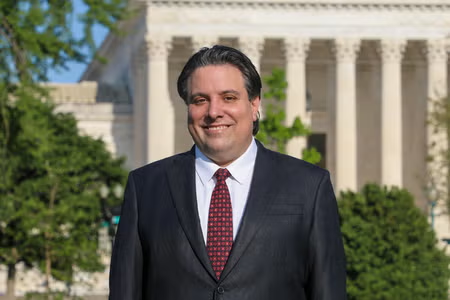
Michael T. Morley, Sheila M. McDevitt Professor of Law and Faculty Director of the Election Law Center, Florida State University College of Law
Professor Morley joined FSU Law in 2018, and teaches and writes in the areas of election law, constitutional law, remedies, and the federal courts. His research focuses on election emergencies, the constitutional right to vote, and the Electoral Count Act, as well as the equitable powers of the federal courts. He is an elected member of the American Law Institute and serves as an advisor for the ALI’s Restatement of Torts: Remedies project. Professor Morley is a member of the Florida Advisory Committee for the U.S. Commission on Civil Rights, and was the 2021 Chair of the AALS Section on Election Law. He has testified before congressional committees, made presentations to election officials for the U.S. Election Assistance Commission, and participated in bipartisan blue-ribbon groups to develop election reforms. The Governor of Florida also appointed Professor Morley to the Criminal Punishment Code Task Force to propose potential revisions to the legislature.
Professor Morley’s work has been published in many of the nation’s top law reviews, including the Georgetown Law Journal, Virginia Law Review, and Northwestern University Law Review. The U.S. Supreme Court has cited Professor Morley’s articles, and he was counsel of record for the successful Petitioner in a landmark campaign finance case. Professor Morley has appeared on C-SPAN, Court TV, Fox News and numerous local news programs, and has been quoted in The Washington Post, Los Angeles Times, Roll Call, Politico, U.S. News & World Report, and a wide range of other national publications.
Before joining FSU Law, Professor Morley was a Climenko Fellow and Lecturer on Law at Harvard Law School. Prior to his experience in academia, he served in government as Special Assistant to the General Counsel of the Army at the Pentagon, as well as a law clerk for Judge Gerald B. Tjoflat of the U.S. Court of Appeals for the Eleventh Circuit. During his tenure with the Army General Counsel’s office, he was awarded the Meritorious Civilian Service Award and the Army Staff Lapel Pin. He also worked as an associate at Williams & Connolly LLP and the Critical Motions & Appeals group of Winston & Strawn, LLP, both in Washington, D.C.
Professor Morley earned his J.D. from Yale Law School in 2003, where he was a senior editor on the Yale Law Journal; served on the moot court board; and received the Thurman Arnold Prize for Best Oralist in the Morris Tyler Moot Court of Appeals.
